 Skip to content

How I work
What we work on today shapes the next lesson.
I do not plan German lessons around a fixed programme that moves forward regardless of the people taking part.
First, I establish what German is needed for and what participants already know. During lessons, I pay attention to which expressions they can use successfully, where difficulties arise and what still needs explaining or practising.
These observations determine what we work on next. I prepare suitable materials and record important points in a digital workbook.
This means you receive more than personal, live online lessons. You receive training that I continue to develop between sessions.


PERSONAL LIVE LESSONS
Correcting a mistake is often the easy part.
The more important question is why it happened.
Sometimes a grammatical foundation is missing. Sometimes the learner knows the rule but cannot yet apply it reliably when speaking. In other cases, the difficulty lies in word choice, sentence structure or organising a thought clearly in another language.
In personal lessons, I can identify these differences and respond to them immediately.
That is why I do not simply correct every sentence. I decide which mistakes we should discuss straight away, when a more detailed explanation would help and when it is better to let you finish expressing your thought first.
We then work on the relevant points with suitable exercises. We can return to anything that is not yet secure in a later lesson.
A correction shows you what the right wording is. A good explanation helps you understand why it works, so that you can use it independently later on.
CHOOSING THE LESSON CONTENT
Personalised means more than letting you choose the topics.
For training to serve its purpose, I consider three things. They determine not only what we talk about, but also which explanations are needed, how demanding the exercises should be and what we need to revisit.
01 · Your requirements
What do you need German for?
In one-to-one training, I take the participant’s professional or personal goals into account. In company groups, the focus is on the language requirements employees have in common.
These requirements determine which vocabulary matters, which types of conversation we practise and what we focus on in written communication.
02 · Your existing knowledge
What can you already do – and where do you still struggle?
I distinguish between a gap in knowledge and difficulty putting knowledge into practice.
Someone who understands a rule may not need another explanation, but targeted practice instead. If the underlying language pattern is not yet understood, that is where we need to start.
03 · Your ongoing progress
What still needs attention?
During lessons, it becomes clear which structures participants are using more confidently and which difficulties keep recurring.
I use these observations when preparing future lessons. This allows us to explore topics in more depth, explain them again or move on to more demanding language tasks.
FROM THE FIRST DISCUSSION TO ONGOING LESSONS
Lesson planning continues to evolve as we work together.
We begin by establishing a shared starting point. After that, I regularly adapt the lessons in response to what actually happens during our work together.
Establish your requirements
We discuss goals, existing knowledge and practical arrangements. For companies, we also consider employees’ responsibilities and the composition of the proposed group.
Prepare the first lessons
I select suitable areas of focus, explanations and exercises. Their scope and difficulty depend on participants’ existing knowledge and the goals we have agreed.
Work together in live lessons
During online lessons, participants do the speaking, formulating and practising themselves. I listen, correct, explain and respond to their questions and difficulties.
Review and develop the material
Important points and additional exercises go into the digital workbook. When planning later lessons, I consider what participants can already use confidently and what still needs work.
An essential part of my work
What we work on in class has a place to live afterwards.
I use digital workbooks that I create and continually expand myself. In one-to-one training, each participant receives a personal workbook. Company groups use a shared workbook tailored to the group’s lesson content and language requirements.
These are not simply collections of generic worksheets. I record important explanations and corrections, collect the vocabulary participants need and create further exercises based on the difficulties we are addressing. The workbook therefore serves both as lesson material and as a resource for independent practice between sessions.
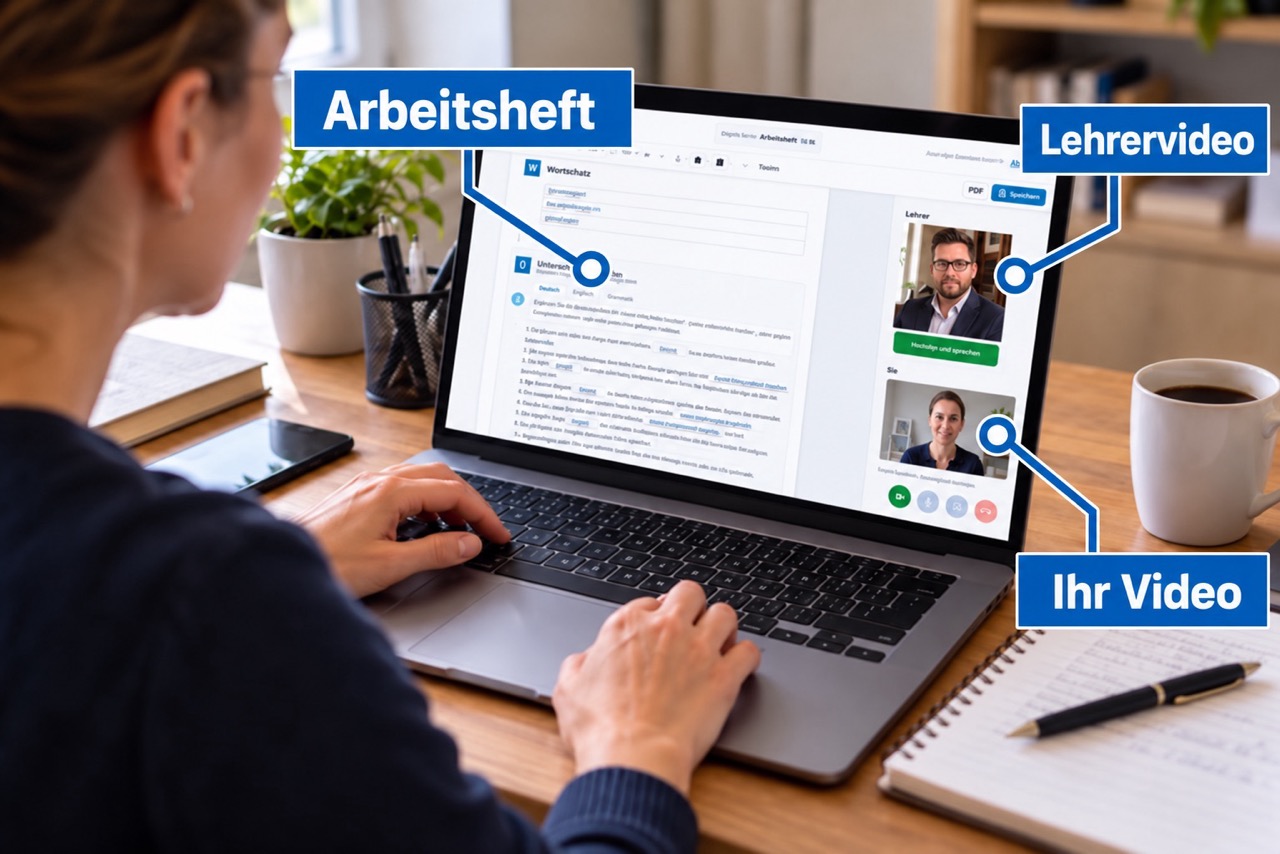
A look inside the digital workbook: lesson content, vocabulary, explanations and additional exercises in one place.
Exercises prepared for specific needs
Exercises relate to the topics covered and the difficulties that actually arise during lessons.
Your own vocabulary collection
Important words and phrases are collected and supplemented with explanations of how to use them correctly.
Understand and revisit corrections
Language explanations are kept in the workbook so that participants can read them again after the lesson.
Review what you have learnt
Participants can continue practising topics we have already covered independently. We return to any outstanding questions during lessons.
What personal language training offers
A correction is not yet an explanation. And an explanation does not yet mean you can use something confidently.
Video courses and AI: useful for the basics
- For getting started and covering general topics: Explanatory videos and AI learning tools can help you become familiar with basic rules, review vocabulary and clarify language questions.
- A conversation is more than a language exercise: A chatbot can simulate a dialogue. But listening to another person, responding to their reactions and making yourself understood in a real conversation are different skills.
- Not every correction preserves what you intended to say: AI can improve the grammar of a sentence. Whether it has truly understood what someone meant and how the wording comes across to the other person is another question.
Personal language training: using German in real conversation
- You speak to a real person: In live lessons, you have to do more than find the right words. You also need to listen, answer spontaneously, ask questions and explain your own thoughts clearly. These are precisely the skills you need later at work and in everyday life.
- We practise what genuinely matters to you: I design lessons around your existing knowledge and the conversations and tasks for which you need German. Exercises reflect realistic communication situations and are supported by suitable materials in the digital workbook.
- You gain experience in personal conversation: Speaking directly with another person helps you deal with uncertainty, respond to unexpected questions and keep talking even when a particular expression does not come to mind straight away. Regular practice and targeted feedback can gradually help you become more confident.
Training options
How can you put this approach to work for you?
The teaching approach is the same. How the training is organised and which content takes priority depend on whether you want to learn German yourself or arrange professional development for your employees.
For businesses
How can you put this approach to work for you?
I offer one-to-one training for employees with particular language requirements and group courses for employees whose responsibilities are similar.
The business training pages explain how these formats are organised.Auf den Firmenseiten erfahren Sie, wie die Trainingsformen organisiert werden.
For individuals
Personal one-to-one German lessons
If you want to develop your German further, we can tailor the content to your work, your everyday life or a specific language goal.
The pages for individual learners explain the different areas of focus.